

Why Tattoo Artists Say Not to Use Aquaphor
Table of Contents
- Why Tattoo Artists Say Not to Use Aquaphor on Fresh Ink
- The Petroleum Problem: What Aquaphor Actually Does to Skin
- How Petroleum-Based Ointments Affect Tattoo Healing Stages
- Signs of Over-Moisturizing a Tattoo (And Why Aquaphor Makes It Worse)
- Ink Leaching, Fading, and Pigment Retention: The Real Risks
- Best Tattoo Aftercare Products: What to Use Instead
- The Professional Debate: Why Some Artists Still Recommend It
- Conclusion
- Frequently Asked Questions
Last Updated: October 1, 2026
Why Tattoo Artists Say Not to Use Aquaphor on Fresh Ink
Walk into almost any shop and you'll hear the same warning: don't reach for the petroleum jelly. Tattoo artists say not to use Aquaphor because its petrolatum base is a heavy occlusive, meaning it seals the skin and traps moisture, bacteria, and plasma against a wound that needs to breathe. At Bigfoot Tattoo Products, we hear this question constantly from clients who were handed a tub by a friend and want to know if it's safe.
The short answer is that it isn't ideal for the first days of healing. A fresh tattoo is an open wound, and how you treat it in the first 72 hours shapes how the ink settles for years. Below, we break down what Aquaphor actually does to skin, the signs you're over-moisturizing, and what to use instead.
The Petroleum Problem: What Aquaphor Actually Does to Skin
Aquaphor's primary ingredient is petrolatum, often listed as petroleum jelly. Petrolatum is an occlusive agent, which means it forms a physical film on top of the skin rather than absorbing into it. That film is excellent for locking moisture into intact, dry skin. On a fresh tattoo, it does something different: it traps whatever is already on the surface, including plasma, lymph fluid, and bacteria, and holds it there.
A common mistake is assuming "more moisture equals faster healing." In practice, a wound heals best in a moist but breathable environment. Occlusives like petrolatum create a seal that blocks airflow, and that seal can slow the natural drying and scabbing process the body uses to close the skin. American Academy of Dermatology guidance on wound care notes that wounds need a balance of moisture and oxygenation, not a suffocating barrier.
How Petroleum-Based Ointments Affect Tattoo Healing Stages
Tattoo healing moves through predictable stages: inflammation, scabbing, peeling, and finally the settling of pigment in the dermis. A petroleum-based ointment interferes most during the first two.
During inflammation, the skin is weeping plasma and the pores are open. A thick occlusive layer traps that fluid, which is a breeding ground for bacterial growth. As the tattoo moves into scabbing, the sealed surface can keep scabs soft and tacky for too long, which makes them more likely to pull off prematurely and take pigment with them.
Inflammation, Scabbing, and the Occlusive Trap
The occlusive trap is simple to picture. You apply a thick layer of petrolatum. It seals the wound. Moisture and bacteria stay underneath. The skin can't regulate its own moisture balance, so it either stays too wet or, once you stop applying, dries out abruptly. That swing is what causes patchy, uneven healing.
Cleveland Clinic overview of how wounds heal explains that the epidermis and dermis repair at different rates, and disrupting the surface layer slows the whole process. A thin layer of a breathable product supports that repair. A heavy seal fights it.
Signs of Over-Moisturizing a Tattoo (And Why Aquaphor Makes It Worse)
The signs of over-moisturizing a tattoo are easy to spot once you know them: shiny, wet-looking skin that never seems to dry, small bumps or pimples forming along the lines, redness that spreads outward, and scabs that stay soft and gooey instead of drying and flaking. Any of these point to a wound that's being kept too wet.
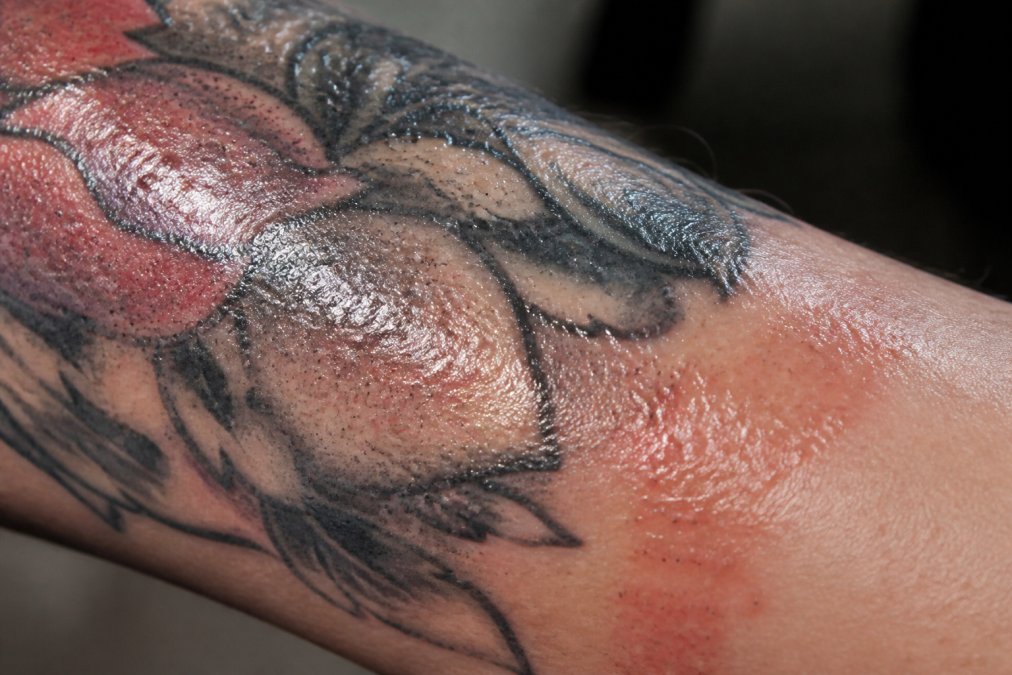
Aquaphor makes this worse because petrolatum is not non-comedogenic in the way a light lotion is. It can clog pores, and clogged pores around a healing tattoo invite bacterial growth and inflammation. If you notice these signs, stop applying the occlusive immediately and switch to a thin, breathable product.
Ink Leaching, Fading, and Pigment Retention: The Real Risks
"Ink leaching" gets thrown around loosely, so it helps to separate two different things. True ink migration is pigment drifting laterally from where it was deposited, which is usually a needle-depth or artist-technique issue, not an aftercare one. What most people actually mean by leaching is poor pigment retention: the skin sheds pigment during healing because the surface was disrupted, so the healed tattoo looks patchy, soft, or lighter than the fresh version. Aquaphor's role sits almost entirely in that second category.
Here's the mechanism. Tattoo pigment sits in the dermis, below the epidermis. During healing, the epidermis regenerates and sloughs, and a thin, dry, well-formed scab or flake layer protects the pigment underneath as that happens. When petrolatum keeps the surface wet and tacky, the flaking layer doesn't dry and detach cleanly. It stays soft, sticks to itself, and pulls away in chunks, sometimes taking pigment-laden cells with it. The result is the classic patchy heal: solid lines in one area, faded or broken lines in another, all on the same tattoo.
A second mechanism is maceration. Skin that stays wet for extended periods softens and breaks down at the surface, a process called maceration. Macerated skin is more permeable and more prone to irritation, and it heals less predictably. When the surface heals unevenly, the pigment beneath it can appear uneven too, even if the ink itself never moved.
What Aquaphor does not do is dissolve or push pigment sideways.
American Academy of Dermatology guidance on wound care and maceration
Best Tattoo Aftercare Products: What to Use Instead
The best tattoo aftercare products share three traits: they're breathable, they're non-comedogenic, and they support moisture balance without forming a plastic-like seal. Look for light balms and lotions built around humectants and gentle emollients rather than petrolatum.
| Product Type | Key Trait | Best For | Watch Out For |
|---|---|---|---|
| Petroleum-based ointment | Heavy occlusive seal | Intact, dry skin only | Traps bacteria, clogs pores |
| Light healing balm | Breathable, non-greasy | Most fresh tattoos | Apply thin layer only |
| Water-based lotion | Humectant, absorbs fast | Later healing stages | May need reapplication |
| Fragrance-free cream | Non-comedogenic | Sensitive skin | Check ingredient list |
Skin Type Considerations: Finding Your Match
Oily and acne-prone skin reacts fastest to occlusives, so those clients should avoid petrolatum entirely. Dry skin can tolerate slightly richer balms but still needs breathability. Sensitive skin should stick to fragrance-free, non-comedogenic formulas to reduce the risk of allergic reaction or dermatitis. If you're unsure, patch-test a small area away from the tattoo first.
The Professional Debate: Why Some Artists Still Recommend It
The disagreement isn't really about whether Aquaphor works, it's about what "works" means, and who's defining it. Tattoo artists and dermatologists are solving for different things, and that gap explains most of the conflicting advice you'll find.
- Oily or acne-prone skin reacts fastest to occlusives. Petrolatum can clog pores around the tattoo and trigger folliculitis-like bumps along the lines. For these clients, skipping petrolatum entirely is the safer call.
- Dry or mature skin tolerates a richer product better, but still needs breathability, dryness doesn't mean the wound should be sealed.
- Humid climates make any occlusive riskier, because the skin is already retaining moisture and the seal compounds it. In high humidity, a light water-based lotion is usually the better fit.
- Dry, low-humidity climates pull moisture from healing skin faster, so a slightly richer emollient balm can help, applied thin, and reapplied as needed rather than layered thick.
- Sensitive or reactive skin should avoid fragrance, lanolin, and heavy occlusives, and patch-test any new product on intact skin first.
Conclusion
The core issue isn't that Aquaphor is a bad product. It's that a heavy occlusive is the wrong tool for an open, weeping wound that needs to breathe. Choose a breathable, non-comedogenic balm, apply it thin, and let the skin do its job.
Frequently Asked Questions
Why not use Aquaphor on new tattoos?
Aquaphor is petroleum-based, which creates an occlusive barrier that traps moisture, bacteria, and ink beneath the skin. This can lead to pore-clogging, skin suffocation, and increased risk of infection. Tattoo artists recommend breathable, non-comedogenic aftercare products that support the healing process without interfering with scab formation or pigment retention.
Can Aquaphor pull ink out of tattoos?
Aquaphor doesn't directly pull ink out, but over-application can cause ink leaching during the weeping phase. When too much ointment sits on a fresh tattoo, it softens scabs prematurely and can draw pigment to the surface. This leads to patchy healing and faded areas. Using a thin layer of a breathable balm reduces this risk significantly.
What is the difference between petroleum-based ointments and modern tattoo balms?
Petroleum-based ointments like Aquaphor form a heavy seal over the skin, blocking breathability and trapping bacteria. Modern tattoo balms use humectants and non-comedogenic ingredients that hydrate without suffocating the epidermis. They support barrier repair, maintain moisture balance, and allow the wound to breathe, which promotes faster healing and better tattoo longevity.
Does Aquaphor clog pores on a new tattoo?
Yes, Aquaphor is highly occlusive and can clog pores on a fresh tattoo. This traps bacteria and debris, increasing the risk of dermatitis, allergic reactions, and bacterial growth. The skin needs to breathe during healing stages to support cell regeneration and prevent inflammation. Non-comedogenic aftercare products are a safer choice for preserving ink vibrancy.
Healing a tattoo well comes down to one decision: what you put on it in the first week. Bigfoot Tattoo Products makes pro-grade aftercare built for exactly that window, with breathable balms that cleanse, protect, and preserve fresh ink through every healing stage. Our formulas skip the filler and get the job done right. Get started with Bigfoot Tattoo Products and give your ink the clean, even heal it deserves.